
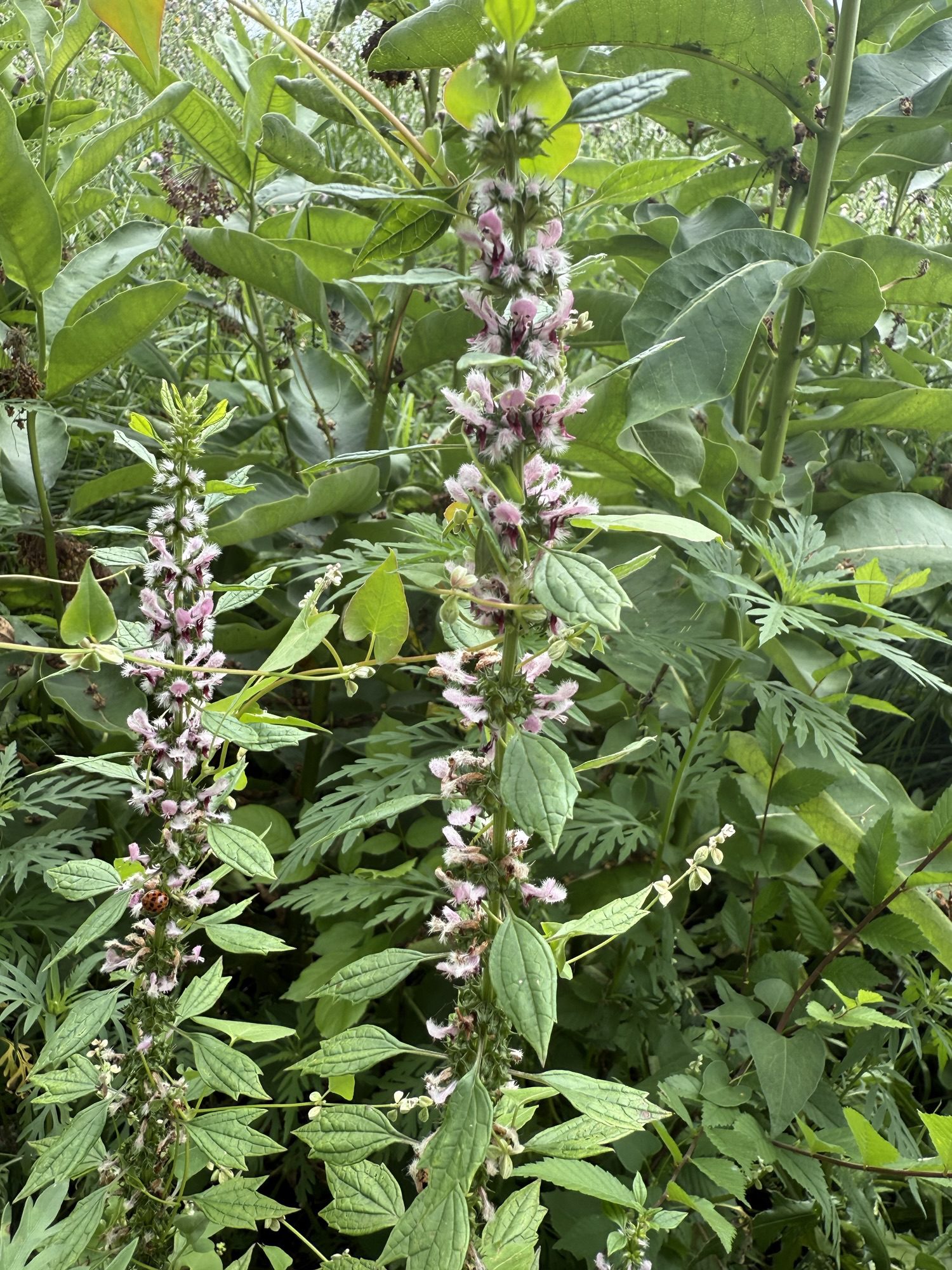
This summer I discovered I have a close connection with motherwort. I foraged a ton last year and transplanted one small plant. This year it popped up all over my yard. Big, beautiful motherwort plants, everywhere I look.
I know we have an aversion to the word “wort,” but when talking about plants we’re using the Old English word for “herb.” So, motherwort is actually “mother herb.” Its scientific name is Leonurus cardiaca, which directly translated means “lion-hearted.”
What a perfect name for the mother herb.
Where to Find It
Motherwort is part of the mint family, although it does not share the strong fragrance of peppermint or spearmint. Instead, it has a more bitter and earthy scent. You will often see it in disturbed places such as along fences, roadsides, and around old homesteads or barns. Once a plant is established, it spreads easily and can take over an area quickly (as I learned).
How to Identify
- Grows 2 to 5 feet tall
- Square stems, typical of the mint family
- Opposite leaves: lower leaves with three deep lobes, upper leaves narrower and lance-like
- Flowers in whorls around the stem, purple to pink in color
- Blooms in mid to late summer

Look-alikes
- Hemp nettle (Galeopsis tetrahit): similar growth habit, but flowers are more tubular and leaves are less sharply lobed
- Nettles (Urtica spp.): sometimes confused with motherwort, but nettles do not have square stems or whorled flowers
Benefits of Motherwort
Motherwort has been valued for centuries in European and Western herbal traditions. Modern research supports some of these traditional uses. The European Medicines Agency recognizes motherwort preparations as helpful for relieving mild symptoms of nervous tension and anxiety.
A clinical study in Russia tested motherwort oil extract in people with both high blood pressure and anxiety. After four weeks, participants reported improvements in emotional symptoms and showed better blood pressure control. Animal studies also suggest motherwort extracts may have calming and heart-supporting effects.
Traditionally, motherwort has been tied to women’s health, especially around menstruation and menopause. It has been used to help ease cramping, bring on delayed menstruation, and support emotional balance during hormonal changes. These associations are likely how it came to be known as the “mother herb.”
Issues to Watch Out For
Motherwort is not for everyone. It should not be used during pregnancy because it may stimulate uterine contractions. Those with heart conditions, or who take medications for the heart, thyroid, or blood thinning, should seek advice from a qualified health professional before using it.
It is also a very bitter herb, which is easy to notice in teas or tinctures. A small amount is often enough.
Final Thoughts
I did not expect motherwort to spread across my yard, but now that it has, I am glad for the chance to get to know it better. I’m incorporating it into a tonic for a little calmness and to help keep me lion-hearted. Sometimes the herbs we need most are the ones that show up at our feet.
References
- Wojtyniak, K., Szymański, M., & Matławska, I. (2013). Leonurus cardiaca L. (motherwort): a review of its phytochemistry and pharmacology. Phytotherapy Research, 27(8), 1115–1120. PubMed
- Shikov, A. N., Pozharitskaya, O. N., Makarov, V. G., Demchenko, D. V., & Shikh, E. V. (2011). Effect of Leonurus cardiaca oil extract in patients with arterial hypertension accompanied by anxiety and sleep disorders. Phytotherapy Research, 25(4), 540–543. Summary
- Maslennikov, P. V., et al. (2021). Phytochemical and Psychotropic Research of Motherwort (Leonurus cardiaca L.) Modified Dry Extracts. Plants, 10(2), 230. Full text
- European Medicines Agency (EMA). (2013). Assessment report on Leonurus cardiaca L., herba. EMA Herbal Monograph

About the Author:
Sabrina Halvorson is an award-winning journalist, author, and UMN Extension Master Naturalist. She serves as president of the Wild Ones Lake Agassiz Region seedling chapter, is appointed to the World Agriculture Forum, and was named the 2024 NAFB Farm Broadcaster of the Year. Learn more at sabrinahalvorson.com.
Leave a Reply