
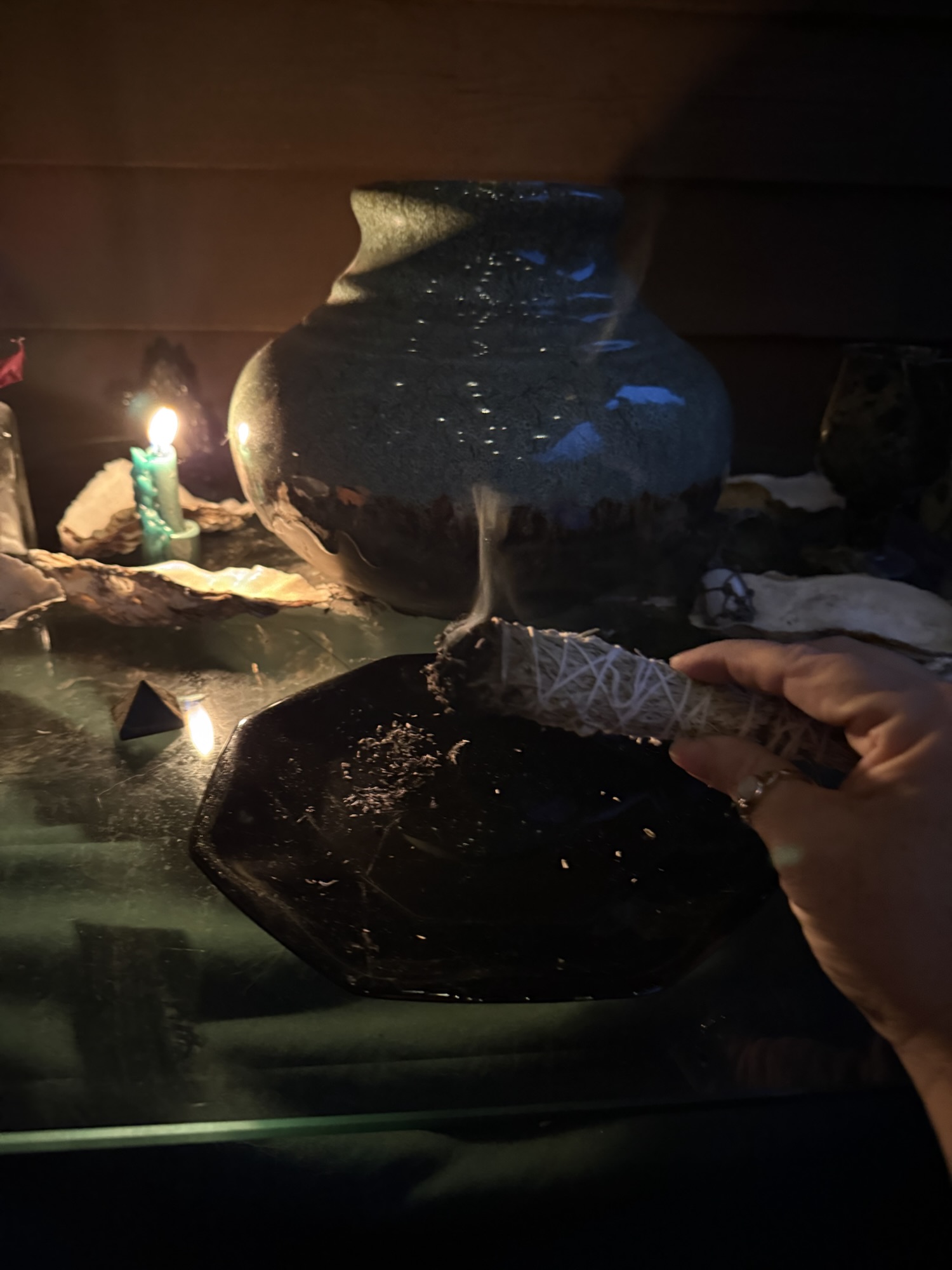
Herbs have been used in ritual, ceremony, prayer, purification, and spiritual practice across cultures and religions for thousands of years. Long before modern herbalism existed as a trend or industry, people around the world burned aromatic plants, prepared sacred oils, carried protective herbs, and used smoke in rituals tied to healing, seasonal observances, household traditions, and religious belief. While the specific meanings and customs varied widely, the connection between plants and spiritual life appears again and again throughout human history.
The Bible
The Bible contains many examples of herbs and aromatic plants being used ceremonially and spiritually. Hyssop appears repeatedly in purification rites throughout the Old Testament, including cleansing rituals described in Leviticus and symbolic purification ceremonies. Frankincense and myrrh were burned as sacred incense and presented as gifts to Jesus after his birth. Bitter herbs became part of Passover traditions, connecting food, memory, suffering, and religious observance. Holy anointing oils were prepared with olive oil, cinnamon, cassia, and aromatic plants for consecration, blessing, and ritual use.
Plants were also closely tied to symbolism and prayer throughout scripture. Olive branches represented peace and reconciliation. Cedars, aloes, and spices were associated with burial preparation and sacred spaces. Even during the crucifixion, the Gospel of John describes Jesus being offered wine on a sponge lifted to him on a branch of hyssop. Throughout the Bible, herbs and plants appear not only as food and medicine, but as part of ritual, worship, purification, remembrance, and spiritual life itself.
Native Americans
Many Native American cultures also have traditions involving sacred smoke and ceremonial plant use, often referred to today as smudging. These traditions vary significantly between tribes and communities, with different plants, teachings, prayers, and ceremonial meanings depending on the culture. Sacred smoke has historically been used for purification, blessing, prayer, protection, transition, and spiritual cleansing. For many Native people, these practices are deeply tied to cultural identity, spirituality, and ancestral teachings, which is why many Indigenous voices consider smudging a closed practice that should be approached respectfully.
The growing commercial demand for “smudge sticks” has also created serious concerns around white sage (Salvia apiana), a plant native to the southwestern United States and northern Mexico. White sage has been heavily overharvested in some areas due to commercial harvesting and illegal poaching on public and tribal lands. Conservation groups and many Indigenous advocates have raised concerns not only about ecological damage, but also about the commercialization of a sacred ceremonial plant traditionally used in Native spiritual practices. Because of this, many herbalists encourage the use of locally grown or personally cultivated herbs rather than purchasing wild-harvested white sage bundles.
Ancient Celts
Ancient Celtic cultures had their own traditions involving sacred smoke and ritual herbs as well. One example is saining, a folk custom historically practiced in Scotland and Ireland for blessing, purification, and protection. Historical accounts describe people burning juniper branches and carrying the smoke through homes, barns, and around livestock or family members. In some traditions, smoke was combined with spoken blessings, prayers, or seasonal rituals tied to household life and agricultural cycles. Unlike the commercial “smudge sticks” commonly sold today, saining was deeply local and practical, using plants that grew nearby and were familiar to the people using them.
Juniper is one of the plants most commonly associated with saining, particularly in Scottish traditions, though other aromatic herbs could also be used depending on the region and local availability. Like many ancient practices, saining existed at the intersection of spirituality, herbalism, folklore, and everyday life. Ancient cultures did not separate medicine, religion, ritual, and connection to the natural world into neat categories the way modern society often does.
Modern Science
Interestingly, some modern scientific research has supported observations ancient cultures made about aromatic plants and smoke. Research on medicinal smoke has found that certain herbal smokes can significantly reduce airborne bacteria in enclosed spaces. Aromatic plant compounds have also been shown to influence mood, stress response, memory, and the nervous system through interactions with the olfactory system and limbic pathways. While ancient people would not have described these effects in scientific terms, many traditional practices were built around direct observation and lived experience.
That does not mean every historical belief about herbs or smoke was scientifically proven, nor does it mean smoke is automatically healthy in all situations. But it does highlight something important: cultures throughout history paid close attention to the effects plants had on the body, mind, environment, and spiritual life around them.
These are only three examples of cultures and religions that use herbs in ritual. There are hundreds more. I love that all over the world, we are connected by our connection to the earth.
References
Bible references:
- Leviticus 14:4–7 — Hyssop used in purification rituals
- Exodus 30:22–25 — Holy anointing oil made with myrrh, cinnamon, cassia, olive oil, and aromatic plants
- Matthew 2:11 — Frankincense and myrrh presented to Jesus
- John 19:29 — Jesus offered wine on a hyssop branch during the crucifixion
Native American traditions / white sage:
- JSTOR Daily: Plant of the Month — White Sage
- California Native Plant Society: White Sage Protection
- Beauty Independent: Native Americans Troubled By The Appropriation And Commoditization Of Smudging
Celtic / saining traditions:
- Oxford Academic: Rites of Purification and Blessing
- Trees for Life: Juniper Mythology and Folklore
- Cailleach’s Herbarium: Saining Not Smudging
Modern science:
- PubMed: Medicinal smoke reduces airborne bacteria
- Citation:
Nautiyal CS, Chauhan PS, Nene YL. “Medicinal smoke reduces airborne bacteria.” Journal of Ethnopharmacology. 2007;114(3):446–451. DOI: 10.1016/j.jep.2007.08.038

About the Author:
Sabrina Halvorson is an award-winning journalist, author, and UMN Extension Master Naturalist. She serves as president of the Wild Ones Lake Agassiz Region seedling chapter, is appointed to the World Agriculture Forum, and was named the 2024 NAFB Farm Broadcaster of the Year. Learn more at sabrinahalvorson.com.
Leave a Reply