
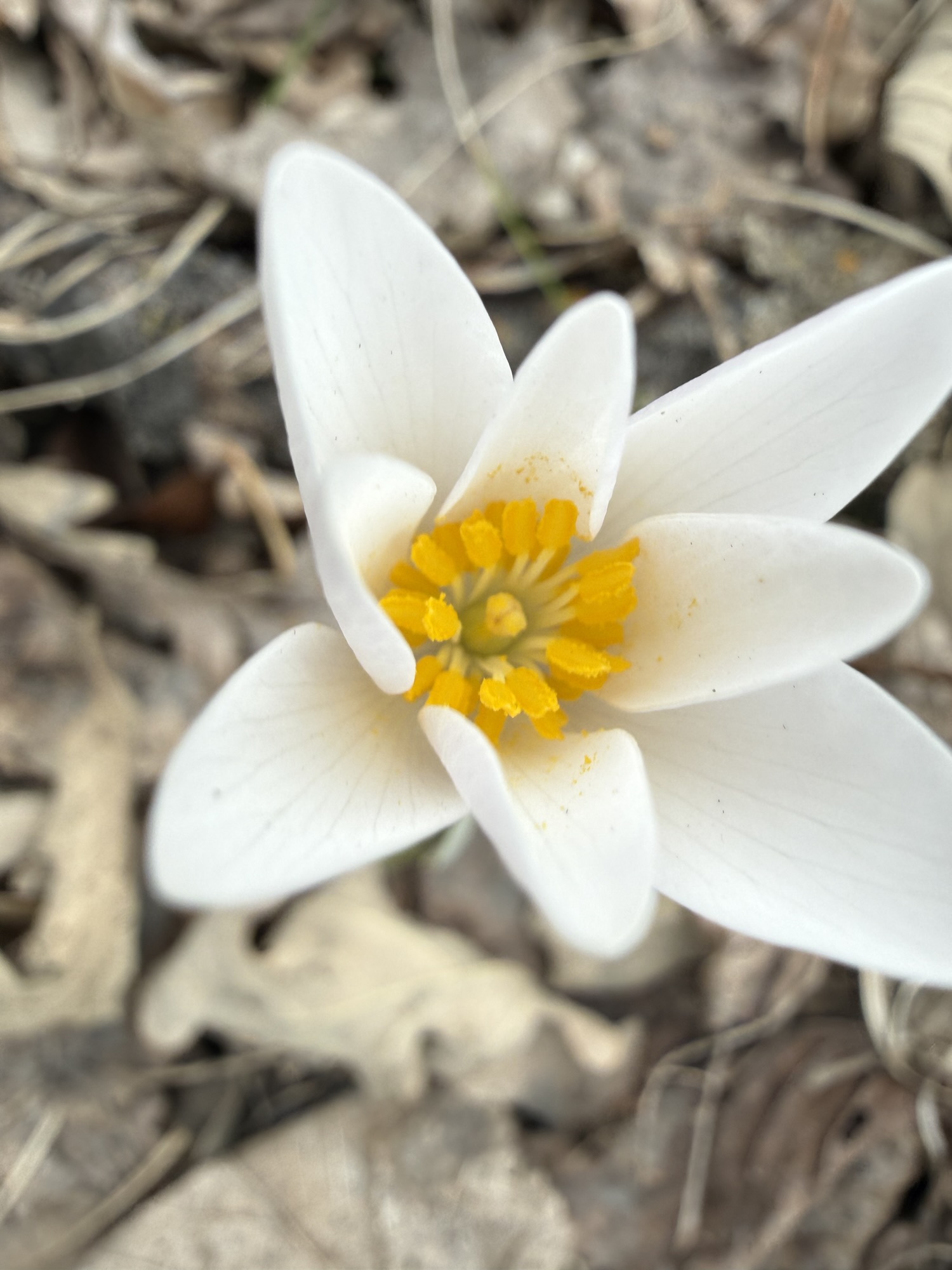
We were out hiking along the Buffalo River in Minnesota, when I spotted a little white flower, popping up among the leaf litter. I was very excited to find this bloodroot (Sanguinaria canadensis) because it was the first time I’d found one in the wild.

Bloodroot is a perennial and native to the Eastern parts of North America. Before moving to North Dakota, I spent most of my life in far Western North America (California), so it’s always fun for me to find plants in the wild here that I wouldn’t see there.
This bloodroot is in Minnesota, which is about as far west as you’ll find the plant growing naturally this far north, though it has been spotted in eastern North Dakota on rare occasions. It does grow a little more to the west the further south you go.

Bloodroot is in the poppy family, in the genus Sanguinaria. It’s the only plant in its genus, which is a little unusual. But, that’s not the only unique thing about it. Bloodroot gets its name from the orange-red sap that leaks from it when you cut the root or break a stem. It looks a bit like the plant is bleeding.
Each bloodroot is a single stem with a single leaf and a single flower. The little white flower opens in the sun but closes at night. They can occasionally grow up to around two feet tall, though they’re usually only about 6-12 inches tall. These I found in late-April were only a few inches.

The red sap is a traditional dye that Native Americans used in war paint and dye baskets and clothing. It’s very important to note that this is not an edible.
Bloodroot is highly toxic and can cause severe poisoning that may be life-threatening if misused. It has been linked to oral leukoplakia, a precancerous condition of the mouth. Bloodroot has also been used in topical products sometimes called black salves, which some people and companies promote as remedies for skin cancer. However, bloodroot can cause skin necrosis, meaning it destroys healthy tissue and can leave deep, permanent scars.
Some people with high levels of herbal knowledge use bloodroot for various things, but it is a plant best left to the experts when it comes to those uses. Also note, it should absolutely never be used by a pregnant person as it is traditionally known to cause miscarriage.
Wild bloodroot is considered vulnerable in some areas due to overharvesting and habitat loss. According to United Plant Savers, bloodroot is listed as “Exploitably Vulnerable” in New York and of “Special Concern” in Rhode Island, though it has not yet been evaluated by the IUCN Red List.
Careless wild harvesting can also impact other species, as bloodroot is sometimes mistaken for twinleaf (Jeffersonia diphylla), a look-alike that lacks the distinctive red sap. Twinleaf is listed as endangered in Georgia and New Jersey and threatened in Iowa and New York, making accurate identification especially important when harvesting.

In addition, nearly all bloodroot sold commercially is wild harvested, according to United Plant Savers, which adds to the ecological pressures on the plant and its lookalike.
All of these things make bloodroot a treasure to find on the trail and I’m really excited that we stumbled across it. I did pick one damaged flower to get a look at the red sap, but the rest we just photographed and left to live by the river.

About the Author:
Sabrina Halvorson is an award-winning journalist, author, and UMN Extension Master Naturalist. She serves as president of the Wild Ones Lake Agassiz Region seedling chapter, is appointed to the World Agriculture Forum, and was named the 2024 NAFB Farm Broadcaster of the Year. Learn more at sabrinahalvorson.com.
Leave a Reply