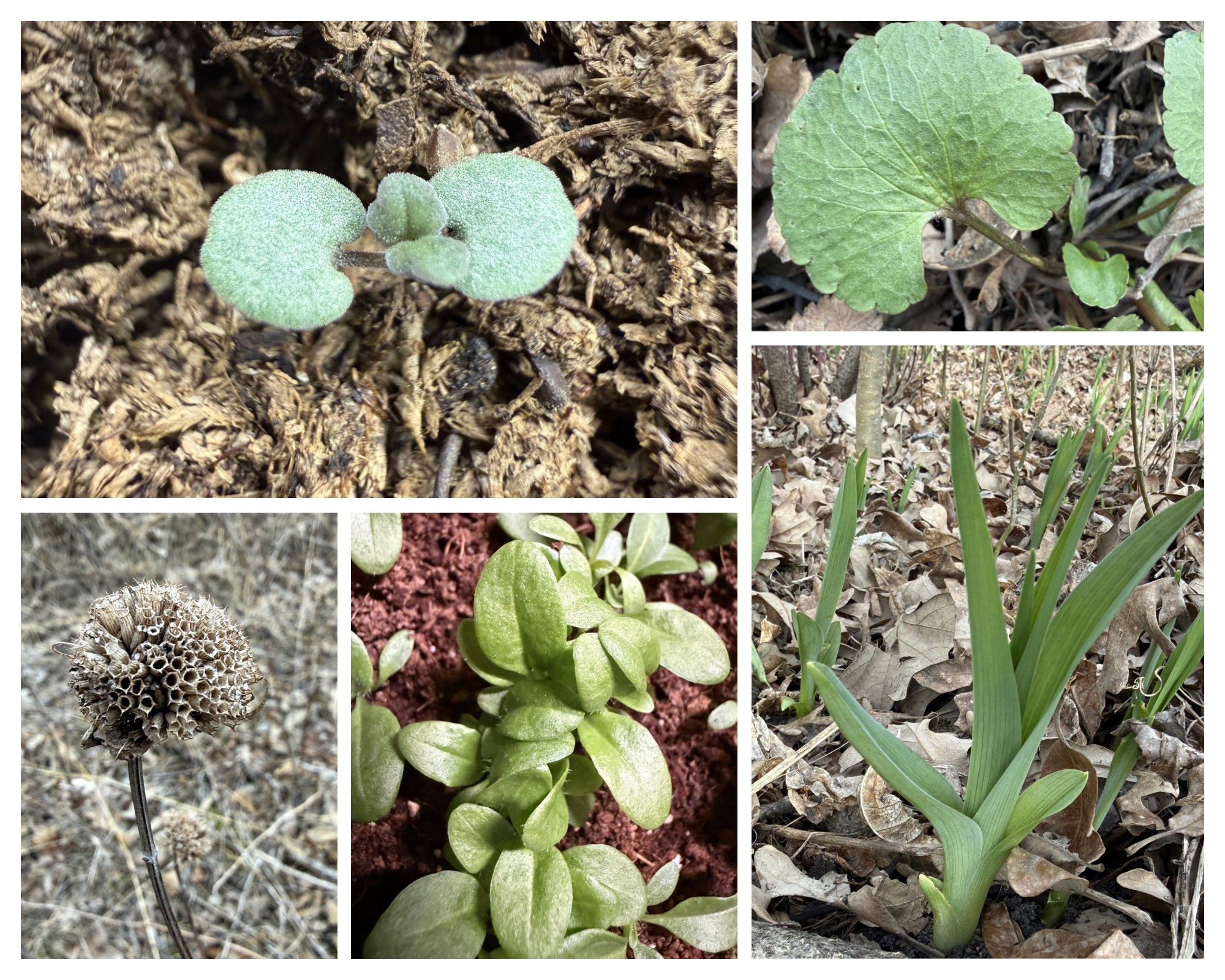
My social feeds are filled with pictures of seedlings or young plants, even some cotyledons, and people asking “What’s this plant?”
The responses are a cacophony of guesses by people who are certain their guess is the right one. Some of them are. Most of them aren’t. I usually try to stay out of it because, frankly, it’s exhausting and frustrating.

The truth of the matter
Here’s the thing: it’s harder to identify a plant in a picture than in person. With a picture, we only use one of our senses. To be good at plant identification, we want to use all of them. (Though I do recommend not using the sense of taste until you’re certain the plant’s not toxic.)
This isn’t to say it can’t be done. Often it can, but very often it can’t. And when you have a hundred strangers giving a hundred different answers, do you really want to trust that? And don’t even get me started on those who reply with “my plant app/Chat/Google says…”
Here’s how we can use all of our senses in plant identification.
Sight
Starting with the obvious one first: sight. There are a number of things sight can tell us about a plant.
Does it have a square stem? If so, it could be in the mint family.
Does it look like yarrow but have a hairy stem? It’s probably Queen Anne’s lace (Daucus carota).
Are the leaves oval or pointed? Alternate or opposite? Bright green, gray-green, tinged with purple?
All of these things give us clues to the plant’s identity. But they’re not the only clues we need. It’s a solid starting point. But it’s not where we should stop.
Touch
When you’re looking at a plant in person, you have the opportunity to feel it. Now, before you head out and start grabbing plants, get familiar with the poisonous plants in your area such as poison ivy, poison oak, or poison sumac.
These all have urushiol, which is a resin that coats the leaves and gives us terrible rashes. Don’t touch those.
They’re not the only ones to avoid. Giant hogweed and wild parsnip are among other plants that can cause irritations. Make these some of the first plants you learn. That will serve you well.
Once you’re sure the plant is touchable, you can feel for fuzzy leaves like silver sage or the obvious mullein.
When you touch the leaf, is it thin like spurge or fleshy like purslane?
You can feel for a rough underside like with burdock.
You can definitely feel the sting of nettle, which some people do on purpose for the pain-relieving benefits.
And a fun one: When you run your finger along the stem, do the leaves fold closed like sensitive plant?
Smell
Smell can also tell us a lot about a plant and help us distinguish between two plants that look alike.
For example, catnip and catmint. These cousins look very similar and can be hard to tell apart until you know them well. The best way to tell which is which is to rub the leaves and smell them.
Catmint, as the name suggests, smells more minty and light. Catnip is musky. I think catnip smells a bit like marijuana (not that I know what that smells like, I swear).
While both catmint and catnip are safe and used medicinally, that’s not the case with a lot of other pairs. For example, Queen Anne’s lace (wild carrot) and poison hemlock. These again are cousins that look alike, but one is edible and the other can kill you.
This is why it’s good to know that Queen Anne’s lace smells faintly like carrots and poison hemlock smells musty, and, frankly, just bad.
One of my favorite plants to use when teaching the power of scent is anise hyssop. When you rub or crush the leaves, they smell strongly of sweet black licorice. I love to use this one with children because it’s such a fun experiment in plant scents.
Sound
Sound is notably the least used sense in plant identification. There’s just not a lot of sound in plants. But that doesn’t mean there’s none.
When you shake the plant, do you hear seeds rattling around in seed pods? That could mean lupine or wild mustard.
Do the stems sound hollow when tapped like sunflowers and goldenrod?
Do the leaves of a tree sound like dozens of pieces of paper rustling together? It could be a quaking aspen.
Another fun sound from plants is the pop some plants make when their seed pods burst open, like jewelweed, or the crack of a splitting milkweed pod.
Taste
Finally we get to taste. Again, because I’m big on people not dying, make sure it’s not toxic before you taste any plant. Once you’re sure of that, taste can be very useful.
Going back to anise hyssop, the plant that smells like sweet black licorice. It also tastes like sweet black licorice, but more mild and a little minty. I don’t like licorice, but I love anise hyssop. It’s my favorite herb and I’m always thrilled when I come across it.
There are other ways taste can help. I find it especially helpful in the mint family. Many look very similar but have different taste profiles.
There’s the classic peppermint and spearmint flavors. A slight lemon flavor points to lemon balm. Apple mint is a little fruity. Chocolate mint has the expected chocolate aftertaste.
But it’s not just the mint family where taste helps.
Wood sorrel is often mistaken for clover, though they’re very different once you know them. One way is the citrusy, sour taste of wood sorrel versus the mild, grassy taste of clover.
There’s the bitter taste of dandelion and the spinach flavor of lamb’s quarters. Mild and sweet chickweed. The root beer flavor of sassafras. That’s actually the other way around. Root beer tastes like sassafras because that’s what it was originally made from.
Putting it together
There’s so much more to identifying a plant than looking at a picture. Yes, cleavers look like cleavers, and bergamot looks like bergamot. But so many plants look very much like other plants, it’s simply not effective and not safe to identify them from a picture.
That’s especially true if it’s young or only leaves.
It’s not enough information to make a positive identification, no matter how much the keyboard experts want you to believe it is.
I know this will get some pushback, but that’s okay. Yes, there are many plants that are easy to identify from just a picture. I can look at a picture of plantain and know it’s plantain. Mullein is quite obvious, once it’s past the young leaf stage. But I’ve also come to know plants from a botanical angle and that helps. Here are some screenshots of why that matters.


And as far as AI goes-it has none of these senses, not even eyes to see the picture you put into it. The best it can do is recognize patterns and compare them to other patterns, then offer you a guess just like all the strangers on Facebook, and often with the same low success rate.
Is an easy identification worth the risk of it being wrong?

About the Author:
Sabrina Halvorson is a journalist and author by profession, herbalist and forager by passion. In addition to her journalism education, she is a University of Minnesota Extension Master Naturalist, the North Dakota chapter coordinator for Herbalists Without Borders, and a graduate of the Chestnut School of Herbal Medicine. Sabrina is the appointed to the World Agriculture Forum, an international council of agriculture experts, and was named the 2024 Farm Broadcaster of the Year from the National Association of Farm Broadcasters. Learn more about her journalism and agriculture experience at sabrinahalvorson.com.
Leave a Reply