
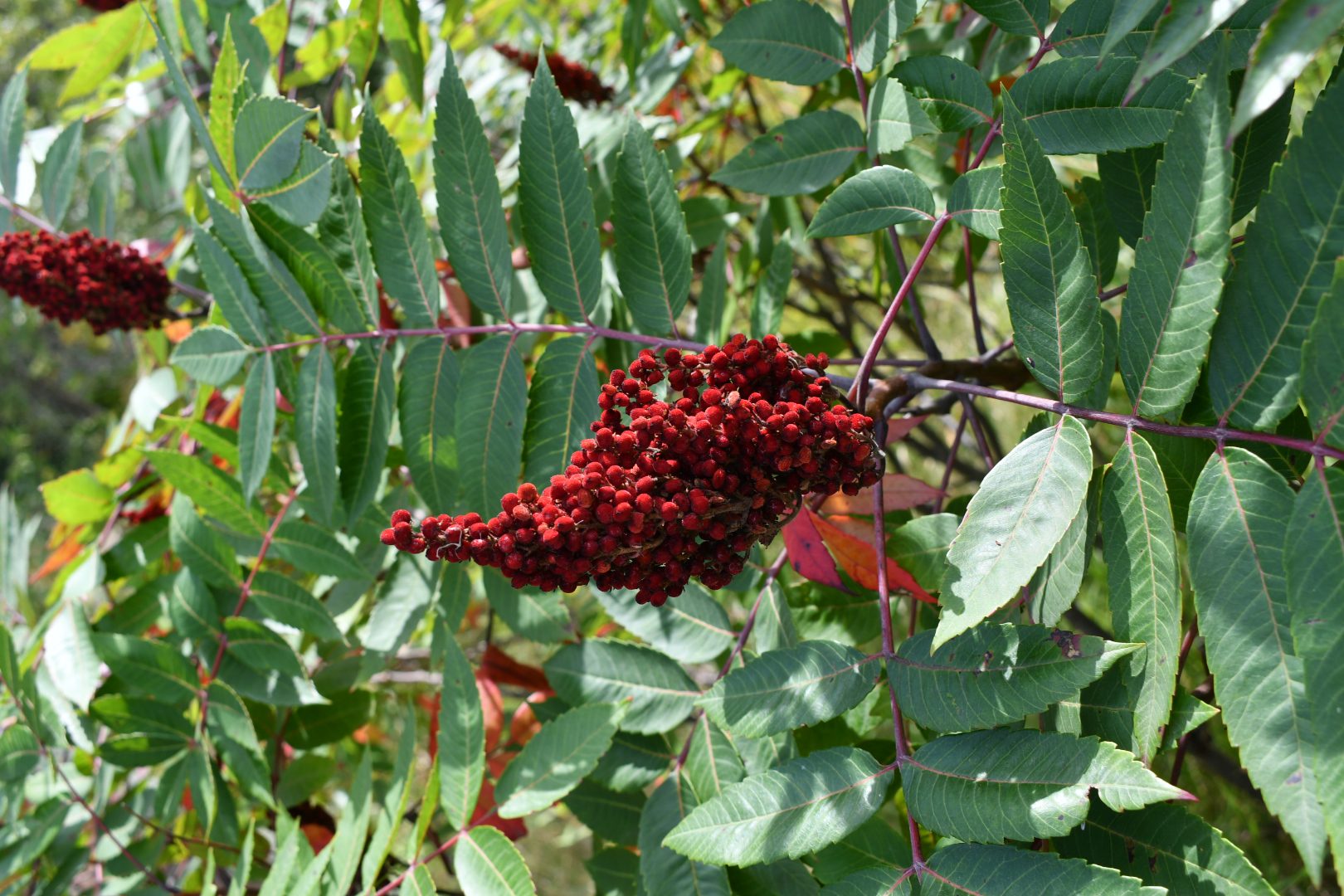
Lemon is a classic taste of summer, but sumac brings that lively zest into fall. I recently went foraging for sumac in Minnesota and came home with several clusters of bright red berries. They’re packed with a strong lemon flavor, and I’ll be using them in a number of ways. One of my favorites is a sumac “lemon” loaf, and I’m sharing the recipe I created below.
This is one of those plants that brings a burst of flavor to foraging. If you’ve noticed the upright clusters of deep red berries along field edges, roadsides, or open woods, you may have found staghorn or smooth sumac. These clusters are often ready in late summer, but in many places, early October is still a good time to collect them, as long as frost has not dulled their taste.
How to Identify
Once you know sumac, it’s very easy to identify.
Staghorn sumac has fuzzy branches, while smooth sumac does not (hence the name). Both have odd-pinnate compound leaves with many leaflets and cone-shaped berry clusters that turn a rich red. In fall, the leaves turn bright red, making the plant easy to spot.
Fragrant sumac is a low, spreading shrub with smaller leaves arranged in groups of three, and its clusters are shorter and more compact. Skunkbush sumac also has leaves in groups of three and tends to grow in dense thickets, often in drier areas.
Fun Fact: Skunkbush gets its name from the strong odor released when its leaves or stems are crushed. Despite the off-putting smell, the berries are edible and have the same tangy flavor prized in other sumac species.

Look-alikes: Poison Sumac
It’s important not to confuse the edible varieties with poison sumac. Fortunately, they’re pretty easy to tell apart. Poison sumac has white or gray drooping berries rather than upright red clusters. It also grows in wet, swampy areas, which is very different from the dry or open habitats where you find staghorn and smooth sumac.
Where to Find Sumac
Edible sumac thrives in sunny, well-drained areas where it has space to spread. Look for it along field edges, prairies, roadsides, and open woodlands. I’ve seen plenty of stands in Minnesota and recently spotted quite a bit on a trip to Connecticut, and it grows widely across much of North America. Smooth sumac is common throughout the Midwest, Northeast, and South, while the staghorn variety is more widespread in northern and eastern regions. Out west, fragrant and skunkbush sumac can also be foraged and prepared much like staghorn and smooth sumac.
Wherever you are, sumac often grows in colonies rather than as a single plant. Once you learn to recognize the cone-shaped red clusters, they become easy to spot even from a distance. The shrubs can reach several feet tall and create striking patches of color in fall when the berries and leaves turn red. Because it is such a hardy and spreading shrub, sumac often comes back year after year in the same places, making it a reliable foraging plant once you’ve located a stand.
When to Harvest
The best time to harvest sumac is from late summer into early fall, before frost and heavy rains arrive. Both can wash away or dull the fine red coating on the berries, which is where most of the flavor comes from. In many regions, September through early October is the sweet spot.
A simple field test is to taste one or two berries right on the cluster. They should have a strong lemon flavor that is tangy and bright. If the flavor tastes flat or weak, the berries are past their prime. It’s also a good idea to avoid clusters that look brown, fuzzy with mold, or waterlogged after a long rain, since they won’t have much flavor.
Sumac holds its color well into fall, which can sometimes make it look harvest-ready even when the taste has faded. Always let the flavor be your guide rather than appearance alone.
Foraging Tips
When you harvest, take only the clusters that still taste bright and tangy. Leave plenty behind for wildlife and for the plant to regenerate. A light shake of the cluster will tell you if the fine red coating is still intact and flavorful. Clip the whole cluster rather than pulling it, which helps avoid damage to the branches.
Once home, spread the clusters out so any insects can leave before you process them. Use the berries soon after picking if you want to make sumac-ade, because the flavor fades with time. For longer storage, dry the clusters in a warm, airy spot until brittle, then keep them in an airtight container. Dried sumac holds its flavor well and can be ground into spice whenever you need a lemony kick in the kitchen.
Read more foraging tips here.
How to Use Sumac in the Kitchen
The berries can be steeped in cool water to make a refreshing tea, sometimes called sumac-ade. They can also be dried and ground into a spice that adds a citrusy punch to cooking, similar to what you find in Middle Eastern spice blends like za’atar. Another option is to simmer the berries into a syrup that can be added to drinks or desserts. The tangy flavor makes it a versatile ingredient for both sweet and savory recipes.
Recipe: Sumac “Lemon” Loaf
This recipe uses a strong sumac infusion to mimic lemon flavor, giving the loaf a bright and slightly tart taste.
Ingredients
• 1 cup milk
• ½ cup dried sumac berries (or 1 full cone, crumbled)
• ½ cup unsalted butter, softened
• 1 cup sugar
• 2 eggs
• 2 cups all-purpose flour
• 1 ½ teaspoons baking powder
• ¼ teaspoon salt
Instructions
1. Warm the milk until just hot, then pour over the sumac berries. Let steep for 30 minutes, then strain to remove the berries.
2. Preheat oven to 350°F. Grease a loaf pan.
3. In a bowl, cream butter and sugar until light and fluffy. Add eggs one at a time and mix well.
4. In another bowl, whisk together flour, baking powder, and salt.
5. Add dry ingredients to the butter mixture alternately with the strained sumac milk, beginning and ending with flour. Mix until just combined.
6. Pour into loaf pan and bake for 45 to 50 minutes, or until a toothpick comes out clean.
7. Cool before slicing.

One of my favorite plants for fall foliage. The leaves turn a stunning red as autumn progresses. (Maplewood State Park, Minnesota)

About the Author:
Sabrina Halvorson is an award-winning journalist, author, and UMN Extension Master Naturalist. She serves as president of the Wild Ones Lake Agassiz Region seedling chapter, is appointed to the World Agriculture Forum, and was named the 2024 NAFB Farm Broadcaster of the Year. Learn more at sabrinahalvorson.com.
Leave a Reply