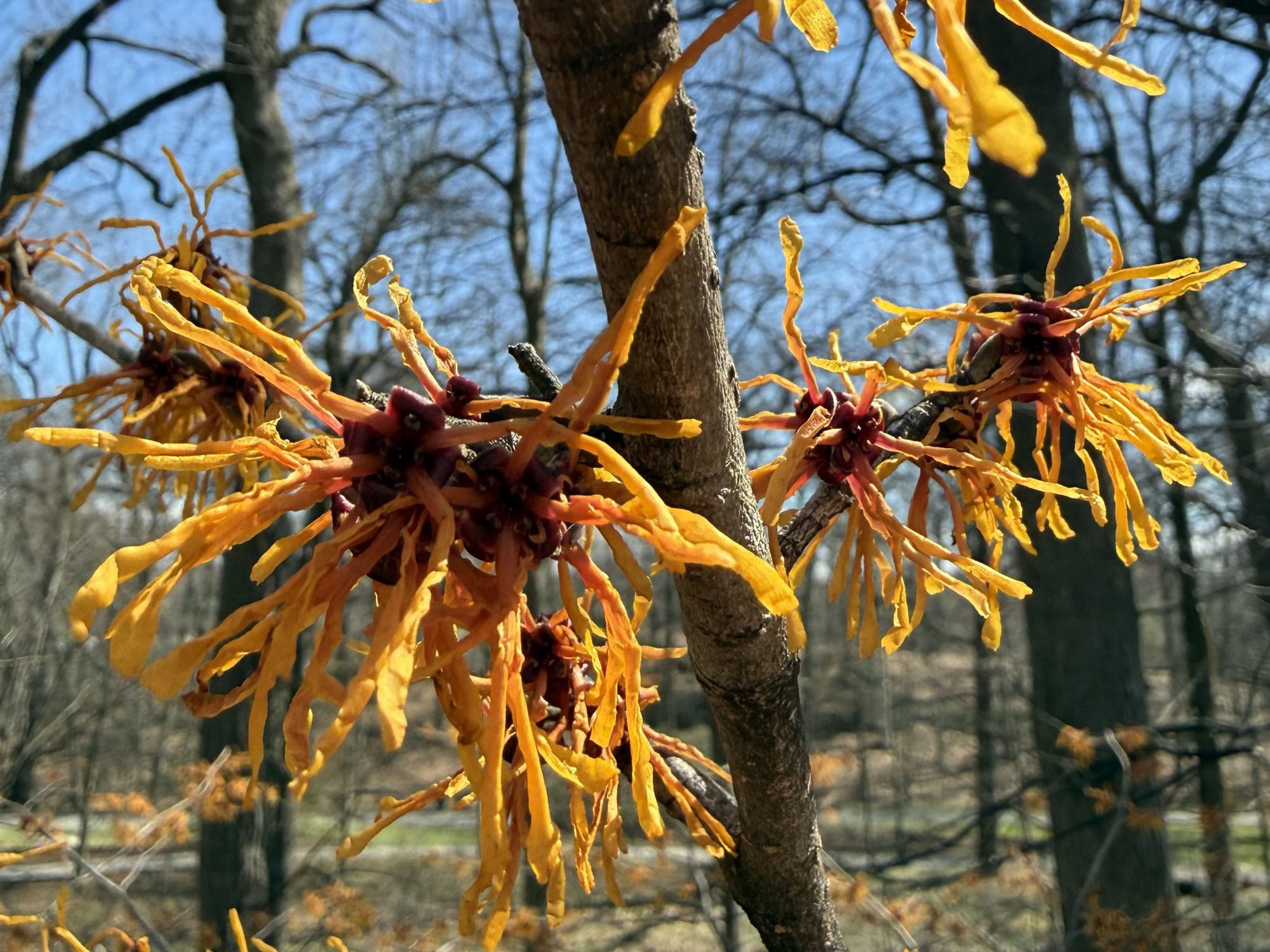
While visiting the New York Botanical Garden last week, I got to see a few different types of witch hazel. I was very excited because, up until now, I’d only read about the shrub and its unique flowers and had never seen one in person.
American witch hazel (Hamamelis virginiana L.) is native to North America. Essentially, if you split the U.S. and Canada in half, you’ll find native witch hazel in the eastern half, top to bottom. You’ll find it growing along the edges of woodlands, around stream banks, and in forest understories. It likes rocky or gravelly soil with plenty of moisture.
The witch hazel was one of the few plants in full bloom when we visited the botanical garden in mid-March.

Deep red blooms from a Japanese witch hazel, photographed at the New York Botanical Garden in mid-March.
The New York Botanical Garden grows several types of witch hazel, including American, Japanese, Chinese, Ozark, and hybrid varieties. The shrubs I photographed were ornamental witch hazels, including Japanese and hybrid varieties, which bloom in late winter or early spring. American witch hazel, the native species we’ll be focusing on here, typically blooms in the fall.
The flowers are small but striking, made up of four narrow, ribbon-like petals that curl and twist into delicate yellow streamers. They grow in small clusters along the bare twigs, often appearing in late fall after the leaves have dropped.
Each flower has a tiny cup-like center and a faint, spicy fragrance. I can verify that the centers are a little rubbery when gently pinched, like soft bubble gum.
American witch hazel has a fascinating way of spreading its seeds. The woody capsules from the previous year often remain on the plant while new flowers appear, and when the capsules ripen, they split open suddenly and eject the seeds several feet away.

Yellow blooms from a witch hazel in early spring, photographed at the New York Botanical Garden on March 21.
Ornamental types, like the ones I photographed at the garden, often have flowers in shades of yellow, orange, or even deep red, while American witch hazel usually has yellow blooms.
It’s not a plant you’d forage for food, but it has many medicinal uses. You’re probably already familiar with the witch hazel you can buy at the drug store. That’s made from a distilling process using the woody parts of the plant. It’s the bark and twigs that make this such a useful find, though the flowers have their own ornamental value.
The distilled witch hazel has many uses, most commonly as a gentle astringent applied to the skin. It is often used to soothe minor irritations, reduce inflammation, and tighten tissues. Traditionally, it has been applied to insect bites, minor burns, cuts and scrapes, bruises, and hemorrhoids. It is also widely used in facial toners and other skin care products because of its ability to cleanse the skin and reduce excess oil while remaining relatively gentle on sensitive skin.

A red-flowered Japanese witch hazel in full early-spring bloom at the New York Botanical Garden, photographed on March 21.
Witch hazel works largely because of compounds called tannins, which are naturally present in the bark and twigs. Tannins have strong astringent properties, meaning they help tighten tissues and reduce minor bleeding and swelling.
When applied to the skin, these compounds can help calm irritation, reduce inflammation, and create a slight tightening effect that many people recognize when using witch hazel products. In addition to tannins, witch hazel also contains small amounts of flavonoids and other plant compounds that contribute to its soothing and anti-inflammatory effects.
The bark and twigs are typically collected during the dormant season, usually in late fall through winter after the leaves have dropped. At this time, the plant’s energy is concentrated in the woody parts, making it an ideal time for harvest. Small twigs and young branches are usually preferred, and only modest amounts should be taken to avoid harming the shrub. Harvesting responsibly ensures the plant remains healthy and continues to thrive.
I like to make simple herbal sprays with witch hazel by putting it in a bottle and adding a few drops of essential oils. Depending on the oils used, it can be anything from a natural mosquito repellent (using eucalyptus and citronella), to a soothing spray for your pillow (using lavender). Shake it before using because the oils don’t fully mix with witch hazel and will float up to the top.
Leave a Reply