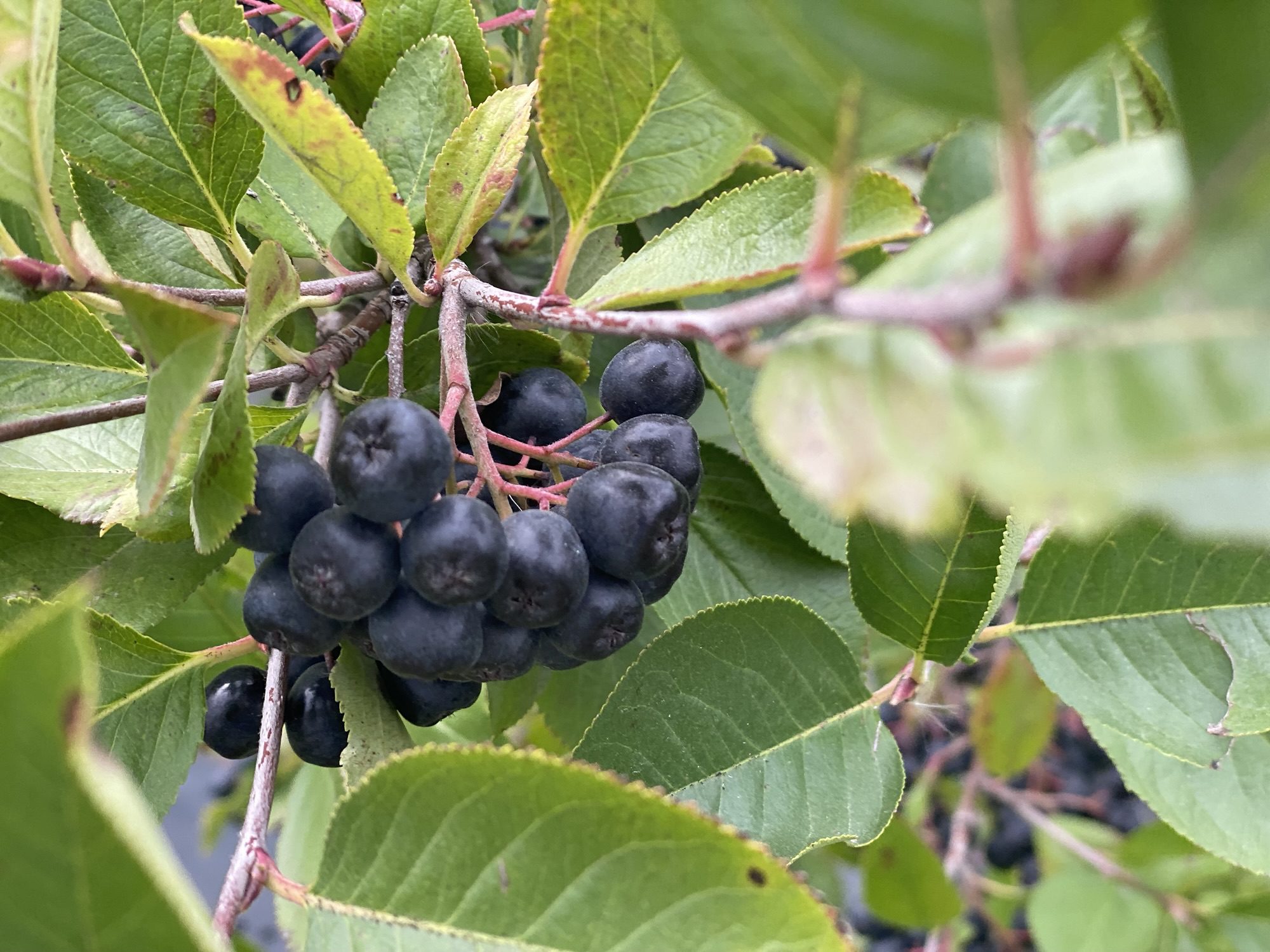
I’m heading to an Aronia harvest festival today, so it’s the perfect time to write about these powerhouse fruits. I swear by these little berries to get me through flu season without getting sick.
Aronia berries, also called black chokeberries (Aronia melanocarpa), are small, dark-purple fruits native to eastern North America. They grow in clusters on shrubs in woodlands, streambanks, and cultivated landscapes. Their flavor is intensely tart and astringent, yet they’re prized for their potent nutritional and bioactive properties.

I’m fortunate to live near an Aronia farm and every year I buy five pounds of berries. I turn them into Aronia syrup, which has become a household staple. I stir it into tea for its rich flavor, and my husband takes a spoonful each day during cold and flu season. If I sense a bug coming on, I’ll take a couple of extra spoonfuls myself.
Why Aronia Is Especially Good During Cold & Flu Season
- Exceptional antioxidant content: Aronia berries are loaded with polyphenol, especially anthocyanins, and deliver some of the highest antioxidant levels of any fruit.
- High in proanthocyanidins: Aronia has among the highest levels of these powerful antioxidants, surpassing most other commonly consumed fruits.
- Antiviral potential: In both lab and animal studies, Aronia extracts, particularly components like ellagic acid and myricetin, have demonstrated activity against various influenza strains, including resistant types.
- Broad respiratory virus support: A standardized blend of Aronia and elderberry extracts showed antiviral activity against several respiratory viruses, including influenza A and a common human coronavirus.
- Anti-inflammatory and immune-modulating effects: Laboratory data show Aronia extracts may reduce pro-inflammatory mediators and help dampen inflammatory signaling.
- Additional cardiovascular and metabolic support: Research highlights benefits for blood pressure, lipid profiles, and blood sugar regulation.

Identification
- Shrub grows 3 to 8 feet tall with multiple stems.
- Leaves are simple, oval with fine teeth, turning red in fall.
- Flowers white to pink, in clusters in late spring.
- Berries mature in late summer to fall, turning dark purple to nearly black.
Look-alikes
- Chokecherry (Prunus virginiana): A tree (not a shrub) with elongated fruit clusters.
- Buckthorn (Rhamnus spp.): A toxic shrub with shiny berries and thorny twigs.
Foraging Notes
- Harvest when berries are fully ripe and deep purple.
- Their tartness usually means they’re best used in syrups, jams, or baked goods.

Aronia Syrup Recipe
Here is my basic Aronia berry syrup recipe. You can easily adjust the amounts to work with the berries you have. You can also add cinnamon or other spices that you enjoy. It lasts in the refrigerator for a year.
Ingredients
- 4 cups fresh or frozen Aronia berries
- 4 cups water
- 1 cup honey (or adjust to taste)
Instructions
Combine berries and water in a saucepan; bring to a boil, then simmer for 30 minutes. Gently mash berries to release more juice. Strain through a fine-mesh strainer or cheesecloth, pressing to extract as much liquid as possible. Stir honey into the warm liquid until fully dissolved. Pour into a sterilized glass jar or bottle.
Use a spoonful in tea for flavor and warmth, drizzle over pancakes, or take directly, especially during cold and flu season.
I hope you love it as much as I do!
References
Kulling, S. E., & Rawel, H. M. (2008). Chokeberry (Aronia melanocarpa) – A review on the characteristic components and potential health effects. Planta Medica, 74(13), 1625–1634.
Jurikova, T., et al. (2017). Black chokeberry (Aronia melanocarpa) and its health-promoting activities. Molecules, 22(6), 944.
Park, S., et al. (2013). Antiviral activity of black chokeberry and its components against influenza viruses. Biochemical and Biophysical Research Communications, 440(1), 14–19.
Vlachojannis, C., Zimmermann, B. F., & Chrubasik-Hausmann, S. (2015). Quantification of anthocyanins in elderberry and chokeberry dietary supplements. Phytotherapy Research, 29(4), 561–565.
Chrubasik, C., Li, G., & Chrubasik, S. (2010). The clinical effectiveness of chokeberry: A systematic review. Phytotherapy Research, 24(8), 1107–1114.
Ochnik, M., et al. (2022). A standardized blend of black chokeberry and elderberry extracts shows in vitro antiviral activity against influenza A and human betacoronavirus-1. Pharmaceuticals, 15(5), 619.

About the Author:
Sabrina Halvorson is a journalist and author by profession, herbalist and forager by passion. In addition to her journalism education, she is a University of Minnesota Extension Master Naturalist, the North Dakota chapter coordinator for Herbalists Without Borders, and a graduate of the Chestnut School of Herbal Medicine. Sabrina is the appointed U.S. Country Director for the World Agriculture Forum, an international council of agriculture experts, and the 2024 Farm Broadcaster of the Year from the National Association of Farm Broadcasters. Learn more about her journalism and agriculture experience at sabrinahalvorson.com.
Leave a Reply